Better concrete finish and faster vertical cycles are the result of a controlled formwork process: a correct panel layout, clean contact surfaces, accurate ties and alignment, a planned pour rate, and safe access for each operation. The same controls matter for columns, shear walls, core walls and retaining walls.
Set out alignment before the pour
Check line, level, plumb, joint condition, tie locations and prop adjustment before reinforcement closes the working area. Formwork should be selected and arranged for the wall height, geometry and concrete pressure. Repeated inspections before concrete placement are more reliable than attempting to correct alignment after a lift is complete.
Make concrete finish a system responsibility
Panel facing, joint seals, release-agent consistency, tie arrangement and cleaning all influence the finish. Concrete placement and vibration are equally important: excessive pressure or poorly managed vibration can affect joints and alignment. A finished surface should be assessed against the project’s specified standard, rather than an assumed visual benchmark.
Build a repeatable cycle
For residential and commercial vertical works, productivity improves when the crew can repeat a defined sequence for installation, reinforcement coordination, pour preparation, stripping and repositioning. Plan component staging, access and working platforms as part of that sequence. Repetition does not remove the need for safety checks; it makes them easier to standardise.
Neo Alumax and Neo Panel applications
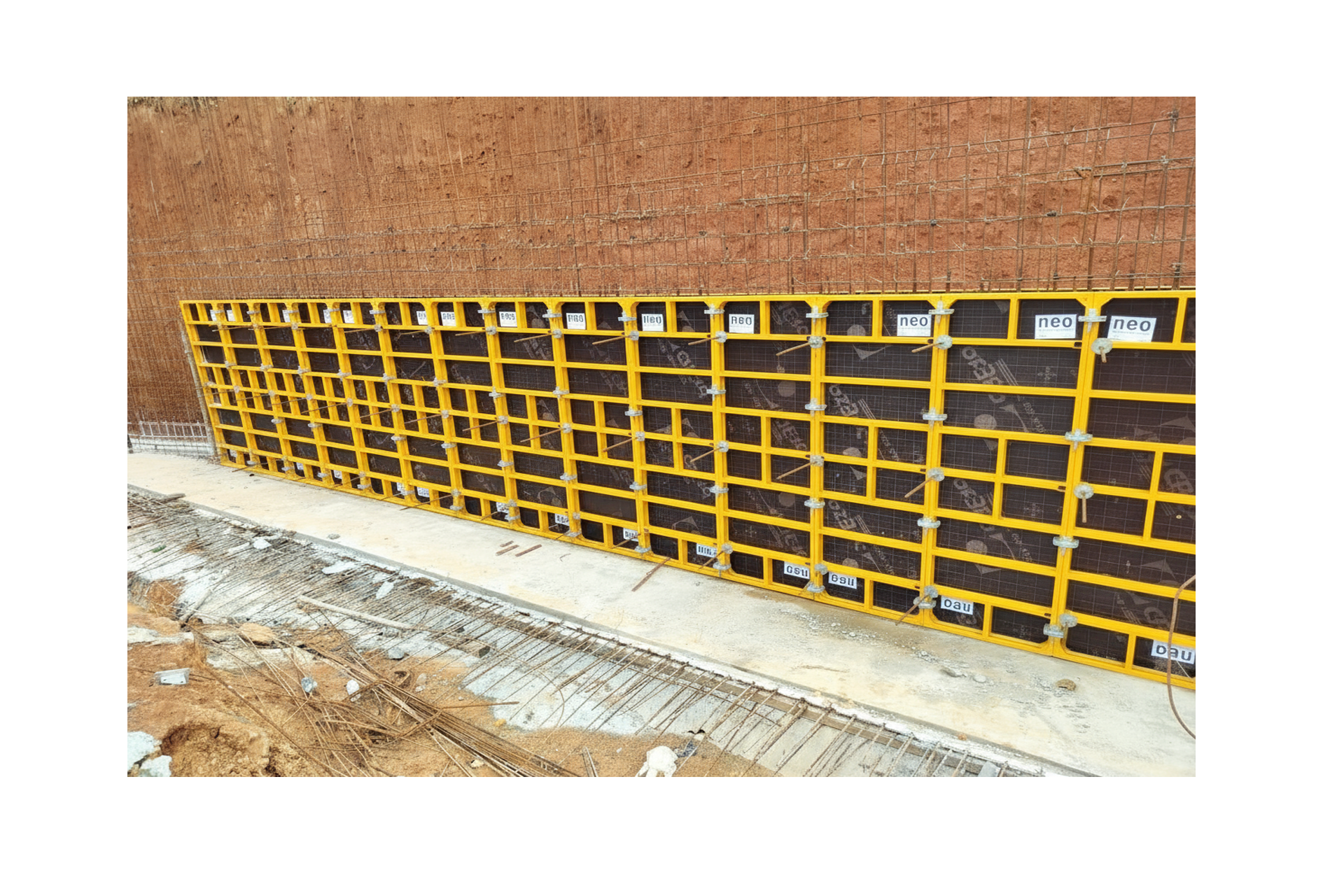
Neo Alumax is Nav Nirman’s aluminium panel system for vertical structures including columns, retaining walls and core walls. It uses aluminium panels, clamps, ties, super plates and alignment props. Neo Panel is a modular steel-panel system for vertical structures including columns, retaining walls and core walls, also using clamps, ties, super plates and props. Both should be reviewed against the final pour height, pressure, panel layout and site access.
Safety and high-rise coordination
High-rise vertical work adds interface risks: lifting, edge protection, access, scaffold or platform coordination and the sequence with slab operations. Include those requirements in the formwork plan early. For cores that move in repeated lifts, a climbing formwork system may also be worth reviewing.
Plan for the element you are casting
Nav Nirman can help project teams review wall and column formwork options for alignment, finish, repeatability and safe site execution.
DISCUSS VERTICAL FORMWORK